Second set of coils in RMM reaches 17 T in a 50 mm cavity
During the past few weeks, the RMM2 demonstrator has been tested at CERN. RMM stands for Racetrack model magnet: this program was launched at CERN in 2015 by D. Tommasini with the goal of demonstrating a 16 T field with a Nb3Sn conductor . The assembly is based on three decks of racetrack coils, with the central deck providing a closed 50 mm cavity.
The magnet reached fields well above 16 T several times in the first assembly, RMM1a, in 2021 and in subsequent configurations, exploring different preload conditions, including a complete disassembly and the introduction of a fishbone structure.
For RMM2, the entire set of three coils was replaced with new, previously untested coils—what we call in our jargon “virgin coils.” The coils were manufactured for the first time using the HFM conductor, namely a 1.0 mm 162/169 subelements with only 0.9 of Cu fraction.
The demonstrator had its first quench above 14 T and then trained rapidly through 15 and 16 T at 1.9 K. A maximum field of 17.0 T in the bore was reached after 15 quenches. A 12-hour holding-current test was also successfully performed. After thermal cycle, first quench was above 16 T. New flat quench antenna were used for this test, allowing a precise localization in several cases. This development could be extended to the whole HFM program, including HTS magnets.
The results will be presented by the SM18 team at the HFM Forum https://indico.cern.ch/event/1732238/ . An overview of the test campaign was also presented by Juan Carlos at ASC in Pittsburgh. This concludes the very successful program launched in the framework of EuroCirCol. At present, no further activities are planned on the RMM front, but if you have ideas or suggestions for additional tests, please let us know ! The magnet will not be disassembled.
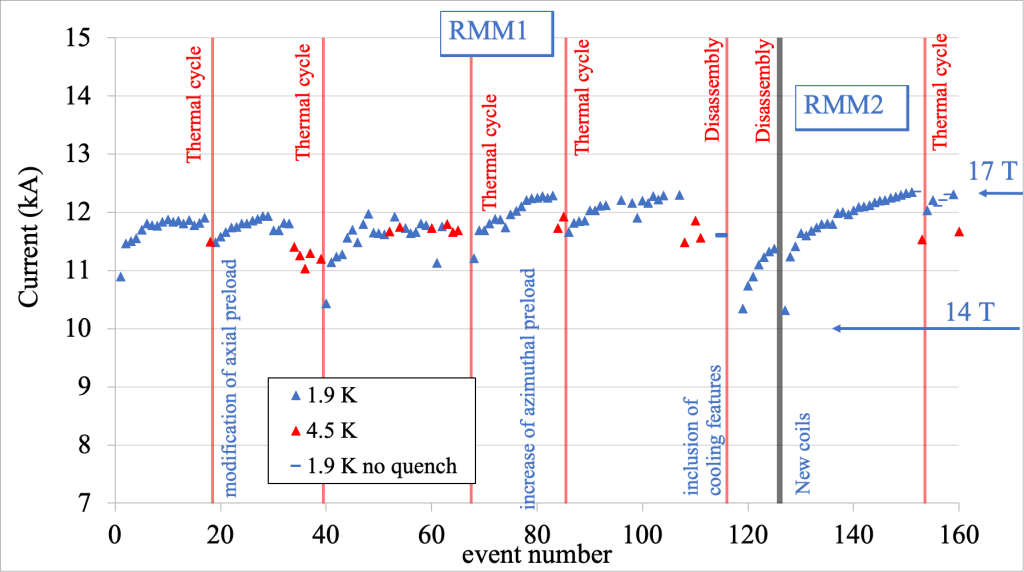
RMM training plot (over several years)
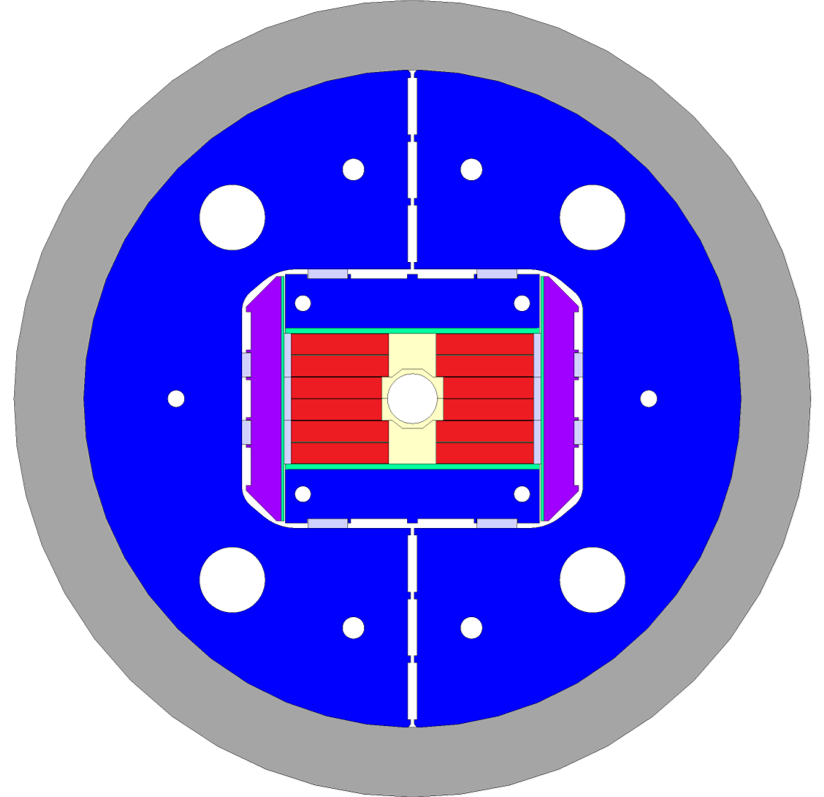
RMM cross section
S. Izquierdo Bermudez, et al. “Design of ERMC and RMM, the base of the Nb3Sn 16 T magnet development at CERN IEEE Trans. Appl. Supercond. 27 (2017) 4002004
E. Rochepault, et al., “3-D magnetic and mechanical design of coil ends for the racetrack model magnet RMM” IEEE Trans. Appl. Supercond. 28 (2018) 4006105
M. Garcia Perez, et al., “Mechanical tests. analysis, and validation of the support structure of the ERMC and RMM magnets of the FCC R&D at CERN”, IEEE Trans. Appl. Supercond. 30 (2020) 4004507
J. C. Perez, et al., “Construction and Test of the Enhanced Racetrack Model Coil, First CERN R&D Magnet for the FCC”, IEEE Trans. Appl. Supercond. 32 (2022) 4005105
E. Gautheron, et al., “Assembly and Test Results of the RMM1a,b Magnet, a CERN Technology Demonstrator Towards Nb3Sn Ultimate Performance”, IEEE Trans. Appl. Supercond. 33 (2023) 4004108