ABOUT HFM
The 2020 update of the European Strategy for Particle Physics (CERN/3493/C/Rev) has identified a need for a reinforced R&D on advanced accelerator technologies, and in particular high-field superconducting magnets, including high-temperature superconductors.
The High Field Magnets R&D (HFM) Programme is the response that CERN has initiated, in collaboration with National Laboratories from the Member States and Associate Member States and linking possibly beyond to ongoing worldwide efforts, particularly in the US and Japan.
The HFM Programme – broad goals are:
- Develop an Nb3Sn accelerator dipole with 14 T operational field for FCC-hh, giving an energy of 85 TeV c.o.m., with a focus on sustainability, cost versus performance, and large scale production;
- Explore the HTS magnet technologies for accelerator applications in the range from 14 T up to 20 T;
- Promote the required developments for superconductors;
- Highlight the innovative of high field magnets developments, both for particle physics instruments different from FCC, and for societal applications.
Reference documents:
1. High Field Magnet Programme – European Strategy Input, March 2025
2. FCC Integrated Programme Stage 2, The FCC-hh (chapter 10.4 on magnets, pages 533-546), input for the European Strategy for Particle Physics (2025)
3. Update of the European Strategy for Particle Physics, June 2020, CERN-ESU-013
4. Deliberation Document on the 2020 Update of the European Strategy for Particle Physics, 5 March 2020, CERN-ESU-014 – EDMS 2477846
The timelines for the HTS and Nb3Sn development
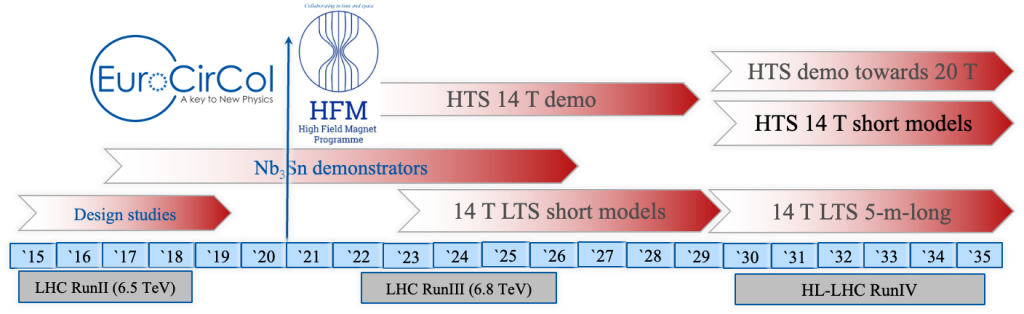
2030: Prove the Nb3Sn technology for several 14 T short model dipoles (having all features for installation in the FCC-hh but length, and with a design scalable in length to 15 m).
2030: Prove the HTS technology for dipole demonstrators (having some of required features as field, aperture, field quality, protection, but not all in the same object).
2035: Prove the Nb3Sn technology for 5-m-long 14 T dipoles (having all features for installation in the FCC-hh but length, and with a design scalable in length to 15 m).
2035: Prove the HTS technology for short model dipoles (having all features for installation in the FCC-hh but length, and with a design scalable in length to 15 m). Explore the 14-20 T field range with demonstrators.
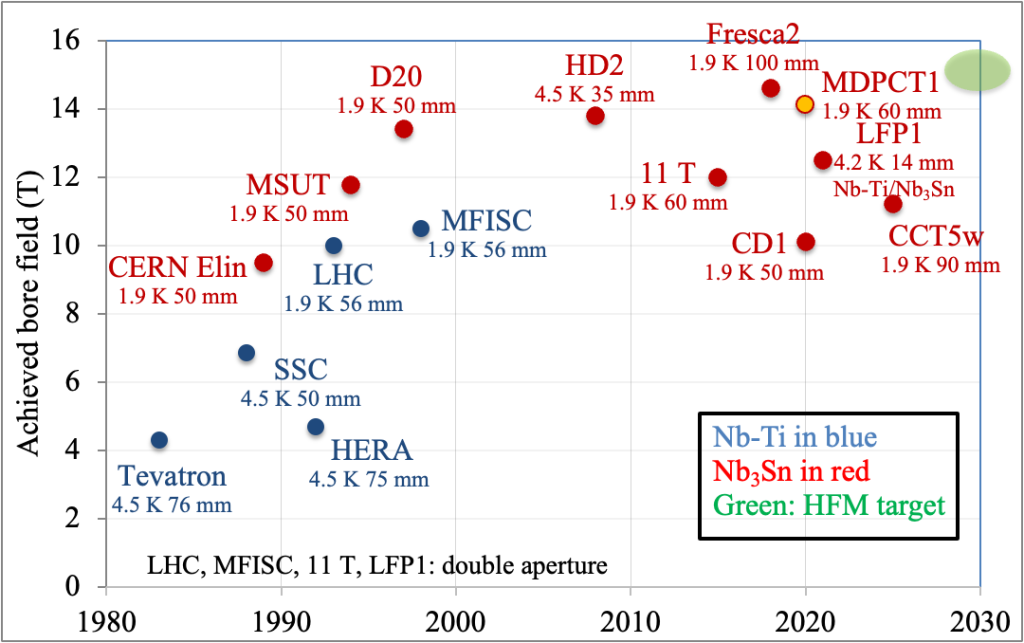
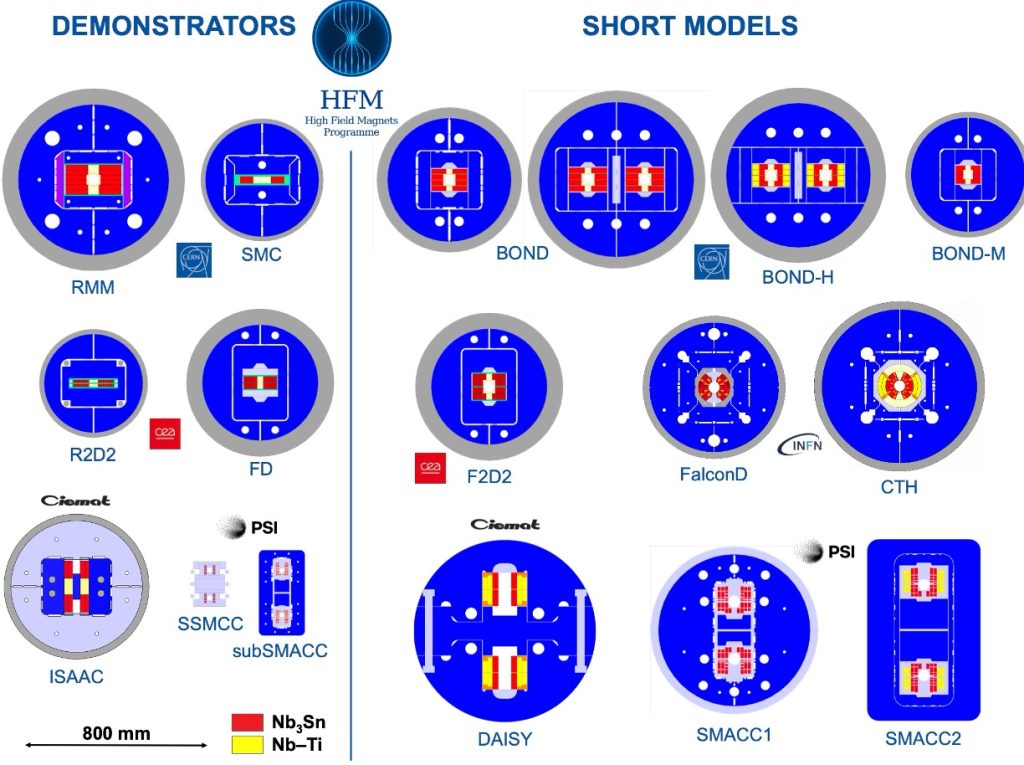
Advancement in LTS short models (with aperture, field quality, and all features needed for scaling)
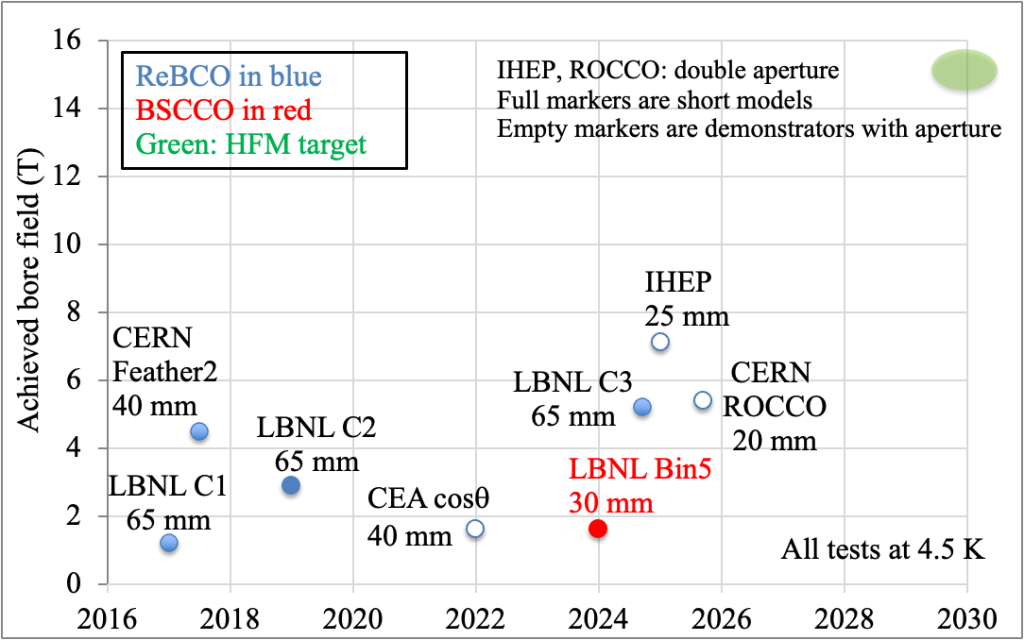
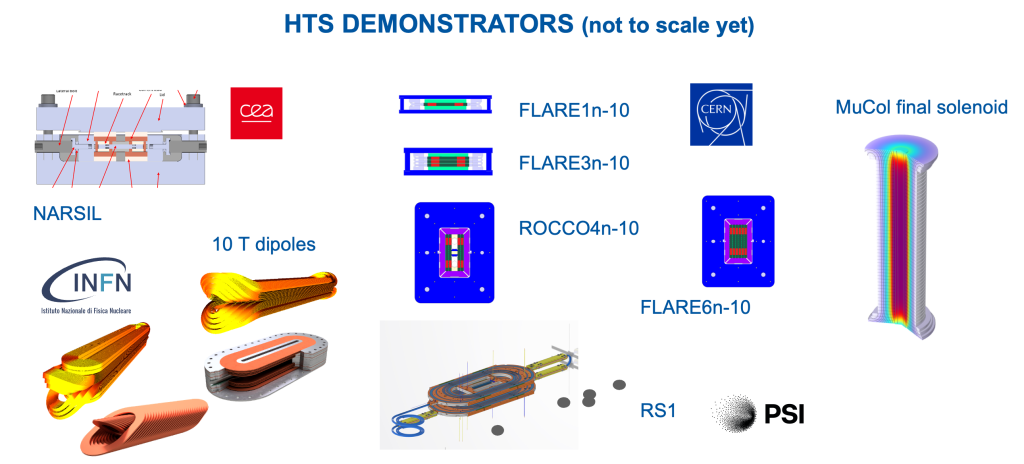
Advancement in HTS demonstrators
What we are building today in LTS (Nb3Sn Nb-Ti)
(see EDMS 3402593 for parameters and EDMS 3355690 for cross-sections)
What we are building in HTS
Timelines for LHC and HL-LHC
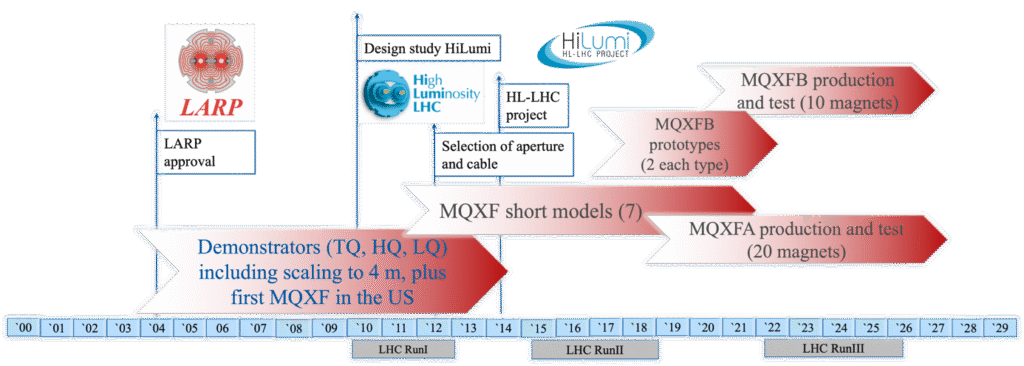
Timeline for the HL-LHC insertion region quadrupoles
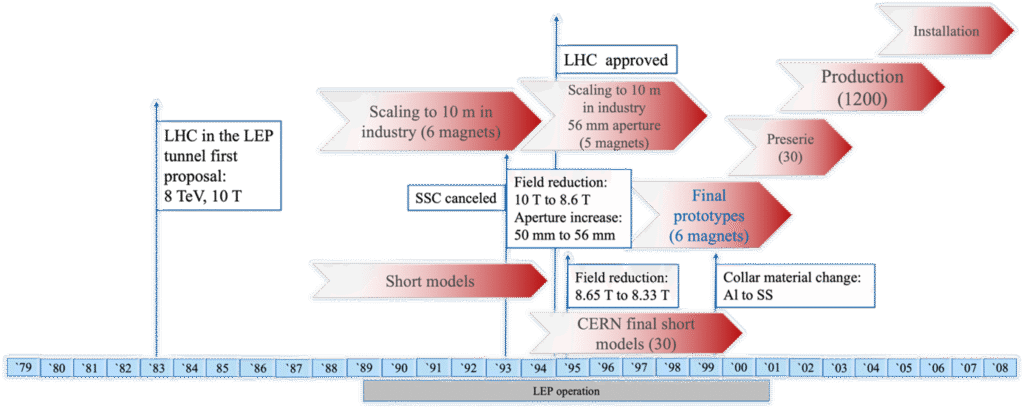
Timeline for the LHC dipole